

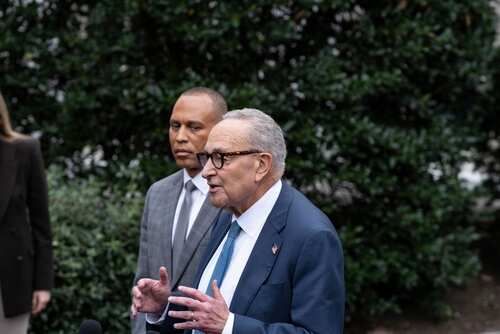
Chuck Schumer is branding ICE and Border Patrol “rogue agencies” while Democrats hold up DHS funding unless enforcement is reshaped on their terms.
Story Snapshot
- Schumer’s latest push targets ICE and CBP with sweeping reform demands tied to DHS funding negotiations.
- Republicans argue key proposals—especially forcing agents to reveal identities—could increase doxxing and threats against officers.
- ICE and CBP continue operating even amid a broader funding standoff because both received billions in 2025 under Trump’s “One Big Beautiful Bill.”
- Schumer has criticized Trump administration plans to deploy ICE to airports, calling it poorly planned and disruptive.
Schumer escalates attacks on immigration enforcement agencies
Senate Minority Leader Chuck Schumer has accused Republicans of fighting for what he calls “rogue agencies,” aiming his fire at U.S. Immigration and Customs Enforcement and U.S. Customs and Border Protection. His comments come as Democrats press for major operational changes to immigration enforcement, including new oversight tools and restrictions, while linking those demands to negotiations over Department of Homeland Security funding.
Schumer’s rhetoric has included claims about ICE culture and conduct, along with warnings that enforcement activity is creating “chaos” in communities. He has also argued that aggressive tactics can harm Americans’ constitutional rights, pointing to allegations of warrantless entries and people being pulled from vehicles. The research provided does not include independent adjudication of those specific allegations, but it does show Democrats elevating them as justification for structural reforms.
Funding standoff meets a Trump-era reality: ICE and CBP already have money
The leverage in this standoff is complicated by prior funding. ICE and CBP received billions in summer 2025 as part of President Trump’s “One Big Beautiful Bill,” meaning a partial shutdown or stalled appropriations would not immediately stop core operations at those agencies. That reality reduces the practical impact of Democrats’ funding pressure while raising the political stakes, since the fight becomes more about policy control than immediate agency survival.
Republicans, now owning responsibility for federal governance in Trump’s second term, are confronting a familiar playbook: use the appropriations process to force policy concessions. The research indicates Democrats are refusing to approve DHS funding without extensive changes to ICE and CBP, while Republicans reject the terms. With border enforcement central to GOP voters, the dispute is likely to sharpen as each side tries to define whether “reform” means accountability or a softening of enforcement.
What Democrats say they want: masks, warrants, cameras, and “sensitive locations” limits
Democratic proposals described in the research include strengthening warrant requirements, requiring agents to display identification, restricting or banning masks during enforcement, mandating body-worn cameras, and adding rules to prevent racial profiling. Other demands include ensuring access to counsel in detention settings and limiting enforcement at “sensitive locations” such as schools and courts. Supporters frame these changes as civil-liberties protections and oversight guardrails.
Some of those ideas are not inherently radical—body cameras, for example, are common in law enforcement debates—but the breadth of the package matters. Limiting where and how enforcement can occur, changing warrant standards, and imposing new constraints on officers’ anonymity would reshape day-to-day operations. For conservatives who prioritize law-and-order and border integrity, the key question becomes whether these changes improve accountability without creating de facto sanctuary zones or reducing the ability to remove dangerous illegal aliens.
Republicans’ pushback centers on officer safety and operational risk
Republicans have largely rejected the reform demands highlighted in the research, particularly “unmasking” requirements, arguing they could lead to increased doxxing of agents. Schumer counters that most police departments operate unmasked, so immigration enforcement should do the same. The core conflict is a tradeoff: transparency for the public versus personal security for agents and their families, especially in a high-temp political environment where online targeting is common.
Schumer has also criticized Trump administration plans to deploy ICE to airports, calling the idea “impulsive” and warning it could produce disruptions. The research notes an added layer of confusion in the public debate, including a reported instance where Schumer misspoke about funding ICE when he meant TSA. Even without that misstatement, the airport issue captures a larger divide: Republicans see visible enforcement as deterrence and sovereignty; Democrats argue it risks disorder and intimidation.
Local backlash in New York shows oversight concerns don’t always map neatly onto party lines
Not every dispute is purely partisan. In the Hudson Valley, a proposed ICE mass detention facility in Orange County drew bipartisan local opposition, with research citing that no elected official—Democrat or Republican—supported the plan. Schumer and Rep. Pat Ryan demanded answers and an investigation into alleged DHS mismanagement tied to the proposal. That episode suggests some communities can oppose specific detention siting decisions even while supporting strong immigration enforcement overall.
For the Trump administration and congressional Republicans, the practical path forward will likely hinge on separating legitimate transparency measures from sweeping operational restrictions that could weaken enforcement. The research provided does not fully detail Republicans’ alternative reform framework or the specifics of incidents cited by Democrats, which limits a complete evaluation. Still, the standoff underscores a bigger 2026 reality: immigration enforcement remains one of Washington’s sharpest fault lines, with constitutional rights and public safety both invoked—and weaponized—in the fight.
Sources:
Immigration officers trained to be ‘nasty, mean and cruel,’ says Schumer
Schumer knocks Trump ‘plan’ to send ICE to airports, says it’s ‘asking for trouble’