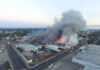


Iran’s latest clash in the Strait of Hormuz tested U.S. resolve, but three American destroyers held the line and left Tehran grasping for a narrative.
Story Highlights
- CENTCOM says Iranian forces launched unprovoked missiles, drones, and fast boats at three U.S. destroyers transiting Hormuz [6].
- U.S. reports no damage; intercepts succeeded and self-defense strikes followed [3].
- U.S. response reportedly hit two locations near Bandar Abbas and Qeshm Island [7][1].
- Iran claims the U.S. struck a tanker first, creating a disputed timeline with no independent verification yet [1][3].
CENTCOM Describes Iranian Attack And U.S. Intercepts
U.S. Central Command stated that Iranian forces mounted unprovoked attacks using missiles, drones, and small boats against three U.S. guided-missile destroyers as they transited the Strait of Hormuz toward the Gulf of Oman on May 7 [6]. Associated reporting identified the trio of destroyers and the combined threat profile from Iran’s fast boats and aerial systems during the passage, underscoring a coordinated harassment attempt in a critical waterway that handles a substantial share of global energy shipping [4][6]. CENTCOM emphasized interception of the incoming threats and immediate self-defense actions [6].
U.S. outlets subsequently reported that no American assets were hit during the exchange, consistent with CENTCOM’s claim that shipboard defenses and supporting assets defeated the attack package [3]. Video reports reiterated the Pentagon’s posture that the United States does not seek escalation but remains positioned and ready to protect American forces operating lawfully in international waters [4][5]. This messaging reflects a deliberate effort to deter further Iranian probing while keeping the incident within the bounds of self-defense, not a broader campaign [3][4][5].
U.S. Self-Defense Strikes And Reported Targets In Iran
A U.S. official told NBC News the military conducted strikes on two locations in Iran near the Strait of Hormuz, aligning with reports of explosions around Qeshm Island and Bandar Abbas [7][1]. Those locations sit adjacent to key Iranian naval and IRGC nodes that have historically supported small-boat swarms and drone launches. While the Pentagon framed the action as measured and defensive, the geographic precision signaled capability to degrade platforms used to menace commercial shipping and U.S. warships without widening engagement scope [7][1].
Parallel coverage captured the administration’s dual-track approach: maintaining freedom of navigation operations and merchant convoy security while pursuing de-escalation to stabilize energy markets and protect allies [5][8]. Headlines describing the event as an “exchange of fire” risk blurring responsibility sequencing, a framing that can dilute deterrence if left unchallenged [2][5]. Officials reiterated the incident began with Iranian aggression, with the U.S. response tailored to neutralize imminent threats and preserve maritime order in a chokepoint long targeted by Tehran’s asymmetric tactics [6][4][5].
Iran’s Counter-Claim And The Evidence Gap
Iranian state media alleged the United States struck an Iranian oil tanker at or near Qeshm before Iranian missiles and drones launched, presenting a mirror-image self-defense claim and accusing Washington of violating a ceasefire [1][3]. Western outlets reported the accusation but could not independently verify Tehran’s timeline, noting the absence of verifiable sensor data or third-party monitoring to resolve who fired first [1]. This evidentiary standoff leaves both narratives competing until radar tracks, ship logs, or satellite imagery are released by authoritative sources [1][6].
Former US Navy Captain Kevin Eyer discusses who currently controls the Strait of Hormuz as tensions between Iran and the US continue.#Iran #US #StraitOfHormuz pic.twitter.com/GCMXddeVvw
— Al Arabiya English (@AlArabiya_Eng) May 8, 2026
For readers tracking accountability, two facts are firm so far: CENTCOM publicly labeled Iran’s attack unprovoked, and U.S. warships reported no damage after successful intercepts [6][3]. Beyond that, independent proof remains limited in open sources. Media emphasis on symmetry between claims reflects this gap, but the onus remains on Iran to explain why missiles, drones, and fast boats closed with U.S. destroyers in one of the world’s most monitored sea lanes. Until credible data surfaces, the self-defense framing stands on CENTCOM’s record and the lack of U.S. damage [6][3][2].
Sources:
[1] Iran fires at ‘enemy units’ in Strait of Hormuz, state-run media claim
[2] Iran and U.S. exchange fire in Strait of Hormuz
[3]
[4]
[5] U.S. and Iran exchange fire as Trump launches mission to guide …
[6]
[7]
[8] US, Iran exchange fire in strait as Trump attempts to open shipping …