

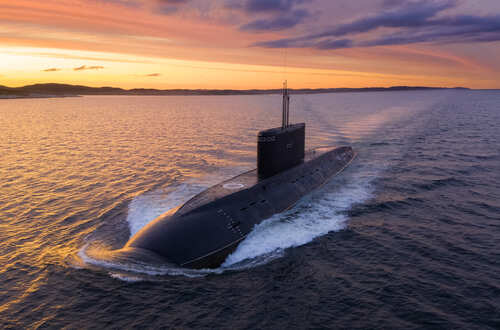
Breaking decades of submarine silence, the administration publicly flagged a nuclear-armed patrol to pressure Moscow—stirring praise for deterrence and warnings about operational risk.
Story Snapshot
- President Trump’s team highlighted a nuclear submarine repositioning to warn Russia after nuclear threats by Dmitry Medvedev [2]
- Experts say submarine deployments are unverifiable, making the publicity a calculated signal without revealing trackable details [2]
- A documented Ohio-class boat’s post-patrol return was shared via official channels, not a real-time location [1]
- Retired operators caution such disclosures buck long-standing norms and could invite risk if pushed too far [3]
What Was Revealed And Why It Matters
News reports describe President Trump disclosing a U.S. submarine repositioning to send a pointed warning to Russian Security Council Deputy Chairman Dmitry Medvedev after renewed nuclear saber-rattling, with backers calling it a pressure tactic to bring Moscow to the table [2]. Separate coverage documents the USS Henry M. Jackson, an Ohio-class ballistic missile submarine, returning to Naval Base Kitsap-Bangor on May 15, 2025, after a routine strategic deterrent patrol, a post-mission detail shared through official channels [1]. These are signals—not live targeting data.
Former Navy captain and Pentagon strategic advisor Gene Moran explains the logic and the limit: submarine deployments are unverifiable, which is the essence of their strategic value, and that makes a public nod “clever” for headlines without handing adversaries a track [2]. Defense analyst Bryan Clark argues the disclosure puts additional pressure on Russia to negotiate, aligning public messaging with deterrence goals [2]. Supporters frame it as firm resolve without compromising the shield that keeps America’s second-strike deterrent credible.
The Break With Tradition And The Risks Critics Flag
Experts also warn of a break with long-standing norms. Moran notes the military “rarely, if ever” talks about submarine movements unless forced by an accident, underscoring how tightly controlled such information is [2]. Retired Navy SEAL Mike Sarraille told Fox News that publicizing movements runs “against the playbook,” a reminder that even general announcements can become political footballs in tense moments [3]. Critics worry that repeated disclosures—even if nonspecific—could dull the edge of strategic ambiguity over time.
Analysts add that tracking American ballistic missile submarines is difficult but not impossible, and the United States has been wrong before when assuming a clean trail [2]. Shoemaker’s assessment, cited in related coverage, warns that proximity to adversary shores raises detection risks, suggesting prudence in how and when officials speak about deployments [2]. These cautions do not prove compromise occurred; they highlight a margin of risk that widens if announcements become more detailed or frequent during crises.
Separating Post-Patrol Facts From Real-Time Locations
The documented image of USS Henry M. Jackson returning to Kitsap-Bangor corresponds to a completed patrol, a type of disclosure the Navy has occasionally made without revealing operational tracks [1]. That distinction matters. Post-event acknowledgments reduce tactical value to adversaries while still broadcasting capability and readiness at home and abroad. Supporters say such messaging counters nuclear bluster from Moscow and steadies allies watching for signs of American resolve [2]. The line between assurance and exposure is drawn by timing and specificity.
Clark’s read is that the current approach applies pressure without burning sensitive details [2]. Moran’s comment that announcements are “clever” because they are unverifiable points in the same direction: headlines without handholds [2]. Both views assume disciplined communication—no live coordinates, no granular patrol windows, and no hints that would aid foreign anti-submarine warfare. The conservative yardstick is simple: project strength, keep secrets, and deter conflict while avoiding self-inflicted vulnerabilities.
Accountability, Deterrence, And Guardrails Going Forward
Conservatives expect transparency on strategy but ironclad protection of tactics. The Pentagon’s broader trend of signaling submarine presence in crisis theaters, including the Middle East, has sparked debate about whether public messaging erodes a tradition that has served deterrence well [3]. Advocates argue that adversaries already know America’s capabilities, and that measured disclosure stiffens spines in allied capitals [3]. Skeptics counter that norms exist for a reason, and repeated exceptions risk normalizing chatter about the quietest leg of the triad.
Two checks can preserve deterrence and public trust. First, keep announcements confined to post-patrol or regionally broad statements that reveal nothing trackable in real time, staying well inside operational security guardrails reflected by the Henry M. Jackson example [1]. Second, ensure every disclosure is tied to a clear strategic purpose—such as countering Russian nuclear threats—with messaging discipline that avoids drift toward political theater [2]. Done right, the signal is strength; done wrong, it invites the very probing our submarines are built to prevent.
Sources:
[1] Web – U.S. Reveals Movements of Navy’s Nuclear-Armed Submarines
[2] Web – Trump lifts veil on US submarines in warning shot to Kremlin in …
[3] Web – Pentagon publicizes submarine movements to the Middle East