

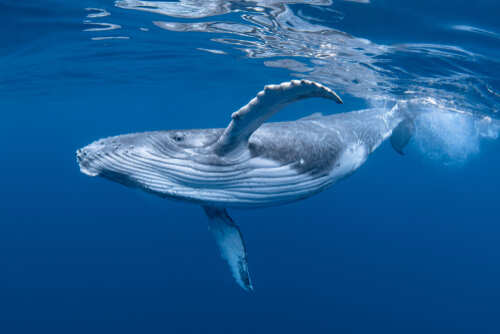
When the ocean turns predatory, a pair of sperm whales showed the world just how powerless a lone human is—and how quickly nature can turn the tables on a shark.
Story Snapshot
- A diver off Mauritius reported two oceanic whitetip sharks closing in aggressively before two sperm whales moved between him and the sharks.
- The diver’s account describes the whales blocking, chasing, and even biting a shark’s tail while keeping close formation around him.
- Oceanic whitetip sharks have a reputation for danger, particularly in open-ocean scenarios involving shipwreck survivors.
- Similar “whale intervenes near human in danger” stories exist, but motivation is difficult to prove from video alone.
What Happened Off Mauritius: A Diver’s Video and a Close-Range Encounter
Diver Benoît Girodeau, also known as the reggae artist Natty Gong, was diving off the coast of Mauritius when he encountered two oceanic whitetip sharks. Girodeau said the sharks approached in an aggressive manner, putting him in an immediate vulnerability gap: open water, limited mobility, and a predator designed for fast, opportunistic strikes. Girodeau’s story gained traction because it includes video and a detailed first-person narration of what happened next.
Girodeau’s account describes two sperm whales arriving and placing their bodies between him and the sharks. He said the whales used deliberate positioning—blocking lanes of approach and forcing the sharks to keep distance. In the sequence described, the whales reportedly opened their mouths to chase the sharks, then shifted depth to manage where the sharks could move. The diver framed it as a direct protective escort rather than a random pass-by.
The Whales’ Tactics: Blocking, Chasing, and a Tail Bite
According to Girodeau, the encounter escalated beyond “close presence” into what looked like active defense. He described one whale diving in a way that kept one shark nearer the surface while the whales maintained control of spacing. Girodeau also said a young female whale took a more direct role, diving upside down and biting a shark’s tail. In his telling, the whales then surrounded him, creating a living barrier until the threat eased.
The public appeal is obvious: a powerful animal appears to side with a vulnerable human against a classic predator. The limitation is just as important. The reporting relies heavily on Girodeau’s narration and the available footage, and neither can definitively prove “intent” in the human sense. The observable facts are movement, proximity, and interaction; the interpretation—protection versus territorial behavior or curiosity—remains uncertain based on the limited documentation.
Why Oceanic Whitetips Matter: Open-Water Risk Is Not a Movie Plot
Oceanic whitetip sharks are repeatedly described as among the most dangerous sharks to humans, especially in scenarios involving ship or plane wreck survivors in open water. That reputation doesn’t mean every encounter ends in an attack, but it explains why divers treat aggressive approaches with maximum seriousness. Girodeau’s story underscores a basic, non-political reality: in remote environments, you do not get a second line of defense unless something—equipment, a partner, or sheer luck—changes the equation.
A Similar Precedent: Humpback Whale Intervention Caught on Camera
Girodeau’s account is not the first time whale behavior has been framed as intervention. Marine biologist Nan Hauser described a 2017 incident in which a humpback whale appeared to position itself between her and a tiger shark. That event was later aired in an Australian TV segment and has circulated widely online. Hauser’s professional background—decades studying whales—adds weight to her observations, even while the same scientific caution applies about interpreting motives.
Big Brains, Limited Proof: What This Story Can (and Can’t) Establish
Some coverage points to sperm whales having the largest brains in the animal kingdom—around 20 pounds compared to roughly 3 pounds for humans—as a reason to assume sophisticated awareness. Brain size, however, does not automatically translate into human-like reasoning or moral intent. The strongest, most defensible conclusion from the available research is narrower: the diver reports that whales physically altered the sharks’ access to him, and the video appears consistent with close, sustained whale presence during the encounter.
For readers used to watching elites pretend they can “manage” reality with slogans, this story lands differently: nature does not negotiate, and it does not care about narratives. What it offers instead is a blunt reminder of humility—humans are not in control offshore, and survival can depend on seconds, positioning, and sometimes an unexpected advantage. The research available offers no verified follow-up, no official investigation, and no definitive explanation of why the whales acted as they did.
Sources:
https://www.surfer.com/news/whales-protect-diver-from-shark-video