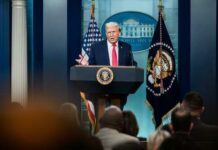


Trump’s new “ask nicely” rule for riot help puts blue-city leaders on the spot while federal agents brace to defend government buildings “very forcefully.”
Story Snapshot
- President Trump told DHS Secretary Kristi Noem that ICE and Border Patrol should not step in to help Democratic-led cities with riots unless local officials explicitly request federal assistance.
- Trump directed federal immigration agents to focus on protecting federal property and warned of harsh consequences for assaults on officers and vehicles.
- The guidance comes amid reported anti-ICE unrest tied to immigration enforcement actions in cities such as Los Angeles, and tensions in other blue jurisdictions.
- Legal and political friction continues over prior federal deployments and enforcement expansions, including lawsuits and court oversight in several states.
Trump’s Directive: Federal Backup Only If Local Leaders Request It
President Donald Trump posted on Truth Social on January 31, 2026, instructing Homeland Security Secretary Kristi Noem to hold back federal intervention during riots or major protests in Democratic-led cities unless local authorities explicitly ask for help. Trump framed the approach as a response to cities he described as poorly run, while still ordering immigration enforcement personnel to stay ready to protect federal buildings. The policy’s political effect is straightforward: local leaders must own their public-order decisions.
Trump’s message also drew a bright line between protecting federal property and providing broader citywide support. He directed ICE and Border Patrol to be “very forceful” when guarding federal buildings and warned about serious consequences for attacks on agents, including incidents involving officers’ vehicles. The focus on federal facilities echoes earlier episodes—such as federal protection of buildings during unrest in Portland in 2020—while narrowing the circumstances for wider intervention to a formal request.
Why Federal Property Protection Is the Non-Negotiable Line
Federal property is not symbolic in these confrontations; it is the physical footprint of national authority, including courthouses and agency buildings. Trump’s directive emphasizes that immigration agents’ default mission during unrest is to secure that footprint rather than police entire city blocks. For conservative readers wary of government overreach, this distinction matters: the order presents a constrained federal posture—defend federal sites, avoid running local streets—unless elected local leadership asks for support.
That narrower stance also shifts the accountability burden to city and state officials who publicly oppose Trump’s immigration enforcement push. If mayors or governors condemn raids but cannot keep order, the White House can point back to the condition Trump set: request help if you need it. At the same time, the “very forceful” language signals that attacks on federal agents or property will be treated as more than routine disorder, especially when protests turn into assaults or vehicle attacks.
Flashpoints Driving the Unrest: Raids, Sanctuary Policies, and Pushback
The January 31 post landed in an environment shaped by months of immigration enforcement pressure in sanctuary jurisdictions. Reporting referenced earlier operations and disputes, including ICE actions in Los Angeles neighborhoods in 2025 and broader enforcement expansion into other blue areas. Those efforts triggered protests and sharpened fights over who controls policing and public safety. In multiple states, the friction spilled into courtrooms, with legal challenges and judicial scrutiny of enforcement-related decisions.
Capital B News also described a web of developments surrounding National Guard use, enforcement surges, and legal resistance, including actions tied to Chicago, Oregon, and Minnesota. Minnesota drew particular attention because of court involvement, including an order for ICE leadership to appear in connection with contempt proceedings. This mix—street protests, sanctuary politics, and active litigation—illustrates the practical problem Trump is addressing: federal agencies can become targets even when they are simply present to execute lawful operations.
What’s Known, What’s Not: Claims, Limits, and Immediate Next Steps
Multiple outlets matched on the core fact pattern: Trump issued the directive on January 31, 2026; Noem was told to avoid intervening in riots without an explicit request; and ICE and Border Patrol were instructed to prioritize protection of federal property with strong force if needed. Beyond that, the data is thinner. Reporting did not confirm any specific post-January 31 deployment decisions tied directly to the Truth Social instruction, leaving outcomes dependent on how protests evolve.
In the near term, the most consequential variable is local leadership. If Democratic mayors and governors refuse to request assistance, they effectively commit to handling violent unrest with their own resources, even while protests are directed at federal immigration actions. If they do request help, they acknowledge limits and invite federal involvement they often criticize. Either way, the constitutional and public-order stakes center on a basic principle: government can debate policy, but it cannot allow mobs to seize streets or attack federal officers.
Sources:
Trump says immigration agents won’t intervene in anti-ICE protests unless asked to do so
Trump vows not help blue cities riots, instructs ICE, Border Patrol protect federal property
Trump warns cities to handle riots, orders ICE, Border Patrol to defend federal property
Trump, ICE protests: federal agents help if ask, Democrat cities
Trump National Guard city updates