

Iran has weaponized a critical chokepoint for 20% of the world’s oil supply, leaving America trapped between military escalation and diplomatic surrender while your energy costs surge and Trump’s promise to keep us out of new wars crumbles.
Story Snapshot
- Iran claims full control over Strait of Hormuz, halting shipping and triggering energy price spikes that hit American wallets
- Trump paused strikes on Iranian targets for 5 days amid backchannel talks Tehran publicly denies, raising questions about secret deals
- Major shipping firms suspended routes through the strait after Iranian threats, creating global supply chain chaos
- The crisis exposes Trump’s broken promise to avoid new wars, fueling MAGA frustration with regime change entanglements and Israel-first policies
Iran Turns Geography Into Economic Warfare
Iran declared de facto control over the Strait of Hormuz on March 24, 2026, warning outsiders to stay away from the narrow waterway between Iran and Oman. Tehran’s leadership asserted regional powers would manage security without needing naval mines, effectively shutting down a corridor that handles roughly 20% of global oil and natural gas trade. This follows U.S.-Israeli strikes on Iranian targets, prompting Tehran to threaten vessel attacks that forced major shipping companies like Maersk, Hapag-Lloyd, and CMA CGM to suspend critical routes. The Atlantic Council characterized Iran’s strategy as converting geography into a global economic weapon, holding international trade hostage with minimal cost.
Trump’s Diplomatic Gamble Amid Mounting Pressure
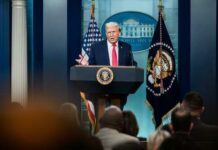
President Trump announced a five-day pause on planned strikes against Iranian energy infrastructure, claiming productive discussions with an unnamed high-level Iranian contact about restricting nuclear weapons development and establishing joint control over the strait. Iran publicly denied any negotiations, contradicting Trump’s assertion of nearing agreement on these critical points. This contradiction raises troubling questions about transparency and what concessions might be offered behind closed doors. Trump extended his ultimatum for reopening the strait by five days, suggesting a “silence of guns” could emerge if talks advance. The political calculus is clear: avoiding an oil shock that would spike prices at the pump and tank financial markets ahead of domestic political pressures.
The Military Escalation Nobody Voted For
The current crisis escalated after coordinated U.S.-Israeli strikes targeted Iranian positions, triggering Tehran’s retaliation through long-range missile launches at the UK-U.S. base on Diego Garcia and intensified Hezbollah attacks on northern Israel. Iranian missiles reached Europe-distance ranges, demonstrating capabilities that directly threaten NATO allies. Emergency responses followed a missile strike in Tel Aviv as Israel continued counter-strikes against Iranian and Hezbollah targets. This represents a dangerous expansion beyond the Middle East theater, pulling American forces deeper into a conflict zone Trump explicitly promised to avoid during his campaign. The reality contradicts the America First mandate that put him back in office.
Economic Fallout Hits Main Street Americans
Shipping disruptions created immediate chaos as vessels anchored in ports rather than risk transit through threatened waters, with insurance costs becoming prohibitively expensive for companies willing to attempt passage. Energy importers across Asia and Europe face supply shortages that ripple through global markets, driving fuel prices upward and straining household budgets already battered by years of inflation from reckless fiscal policy. The situation compounds earlier Red Sea disruptions caused by Houthi attacks, forcing costly reroutes around Africa that add weeks to delivery times and thousands to shipping expenses. American consumers bear these costs through higher prices for everything from gasoline to groceries, while stock markets fall on uncertainty about energy availability and the risk of broader regional war.
By threatening the Strait of Hormuz, Iran turns geography into a global economic weapon
The Broken Promise Dividing MAGA
Trump supporters who voted against endless regime change wars now watch their president navigate the same Middle East quagmire that drained American blood and treasure for decades. The unspecified nature of talks with Iran, combined with proposals for joint strait control, suggests potential arrangements that could legitimize Tehran’s territorial claims while failing to address core security concerns. India’s diplomatic efforts and coordination among NATO allies including Japan, South Korea, and Australia highlight how this conflict serves globalist energy security interests rather than American sovereignty. MAGA voters questioned why American military resources protect international shipping lanes and Israeli strategic objectives instead of securing the southern border and lowering domestic energy costs through unleashed American production.
Sources:
Atlantic Council: Iran Turns Geography Into Global Economic Weapon